
The ‘Manchester Ripple Effect’: Why Trafford and Salford are benefiting from the city’s continued growth
By Samual Sadler, CEO of Lion Rose Holdings.
For years, the Manchester property story has centred on the city centre.
New apartments, expanding employment, population growth and billions of pounds of regeneration have transformed the skyline and helped establish Manchester as one of the UK’s most prominent regional property markets.
But the next phase of that story may increasingly be happening outside the traditional city-centre core.
Two areas in particular stand out: Trafford and Salford.
Both sit immediately alongside Manchester, both are benefiting from major regeneration programmes, and both offer investors something slightly different.
Why look beyond Manchester city centre?
Successful cities rarely grow neatly within their original boundaries.
As employment increases, infrastructure improves and central locations become more established, demand can begin to spread into surrounding areas.
For property investors, that can create an interesting combination:
proximity to an established economic centre + new regeneration + changing demand.
The important point is that buying near Manchester is not enough on its own. Investors still need to understand what is actually driving an area forward.
In Trafford and Salford, there are some significant projects doing exactly that.
Trafford: regeneration on a huge scale
Trafford is already one of the more established and valuable property markets in the North West.
The average Trafford property reached approximately £397,000 in June 2026, up 9.7% year-on-year, making it the highest average house price of any local authority in the North West at the time. Average private rents reached £1,367 per month in July.
But for investors looking ahead, the existing market is only part of the story.
TraffordCity continues to expand
TraffordCity has already attracted around £3 billion of investment, and further development is continuing across residential, leisure, commercial and infrastructure projects.
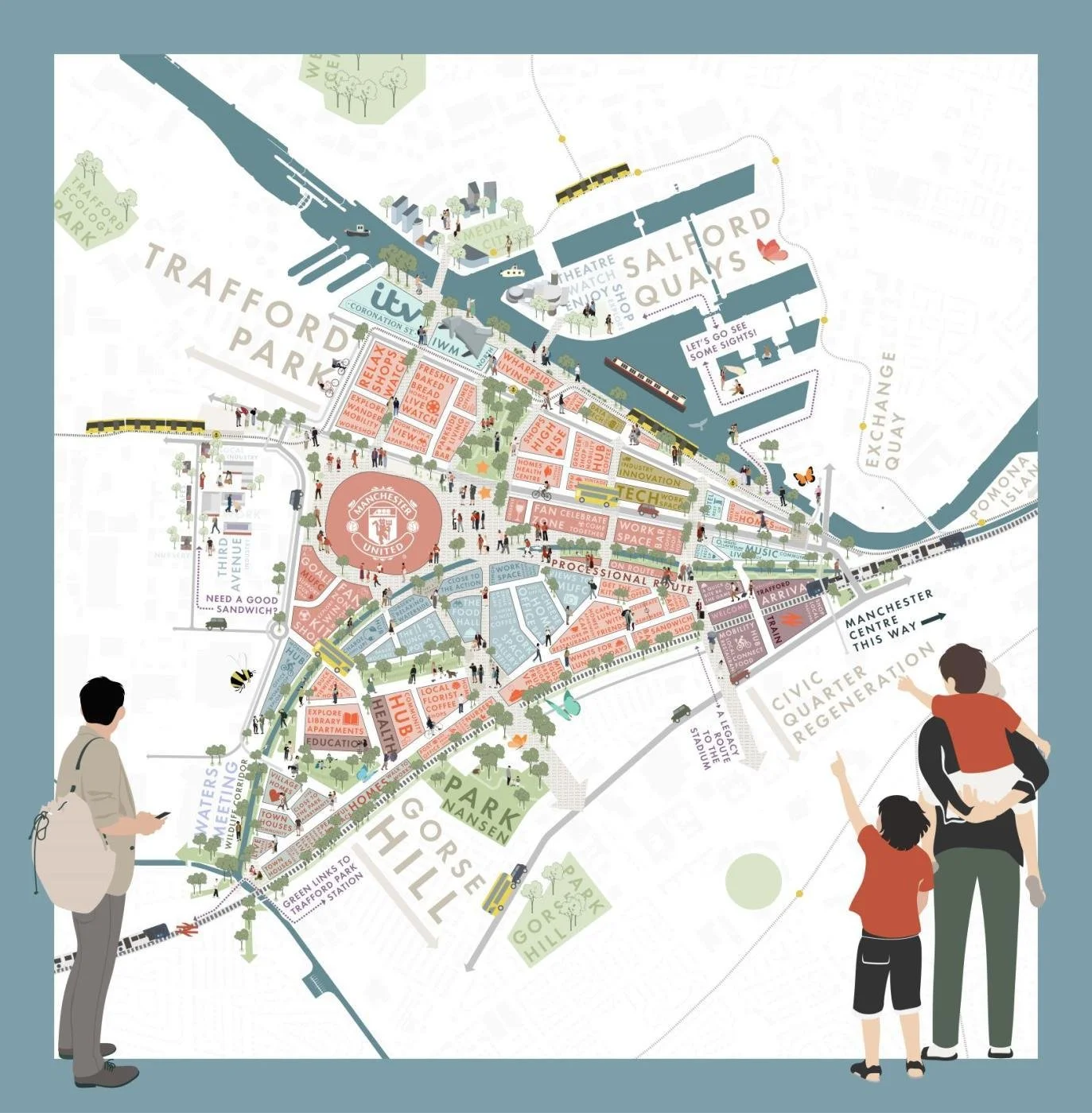
One of the largest schemes is Trafford Waters, a new 53-acre community planned beside the Manchester Ship Canal.
The development is expected to deliver:
3,000 new homes
homes for around 5,000 residents
a new school and health facilities
around 800,000 sq ft of commercial workspace
new public spaces and amenities.
Then there is the much bigger transformation proposed around Old Trafford.
The Old Trafford Regeneration Mayoral Development Corporation formally launched in 2026, with ambitions for a 370-acre regeneration area incorporating up to 15,000 homes and 48,000 local jobs, alongside plans centred around a potential new Manchester United stadium. Trafford Council says the wider development could contribute more than £7 billion per year to the UK economy.
For investors, that scale matters.
Regeneration at this level is not simply about adding new apartment buildings. It can change how an area is connected, where people work, what amenities are available and ultimately how desirable it becomes as a place to live.
Why Trafford interests property investors
Trafford already benefits from several things investors typically look for: an established residential market, strong connectivity, major employment areas and recognised leisure destinations.
What makes the current period particularly interesting is the amount of additional investment still in the pipeline.
Projects such as Trafford Waters, Therme Manchester and the wider Old Trafford regeneration could continue reshaping the area for years rather than months.
That makes Trafford particularly relevant for investors whose strategy places greater emphasis on long-term capital growth.
It is also why developments positioned close to this regeneration can be worth examining individually. The question should always be whether the entry price, specification and rental proposition make sense alongside the wider location story.
Salford: Manchester’s growth next door
Cross the River Irwell and the investment story looks slightly different.
Salford has already undergone one of Greater Manchester’s most recognisable regeneration stories.
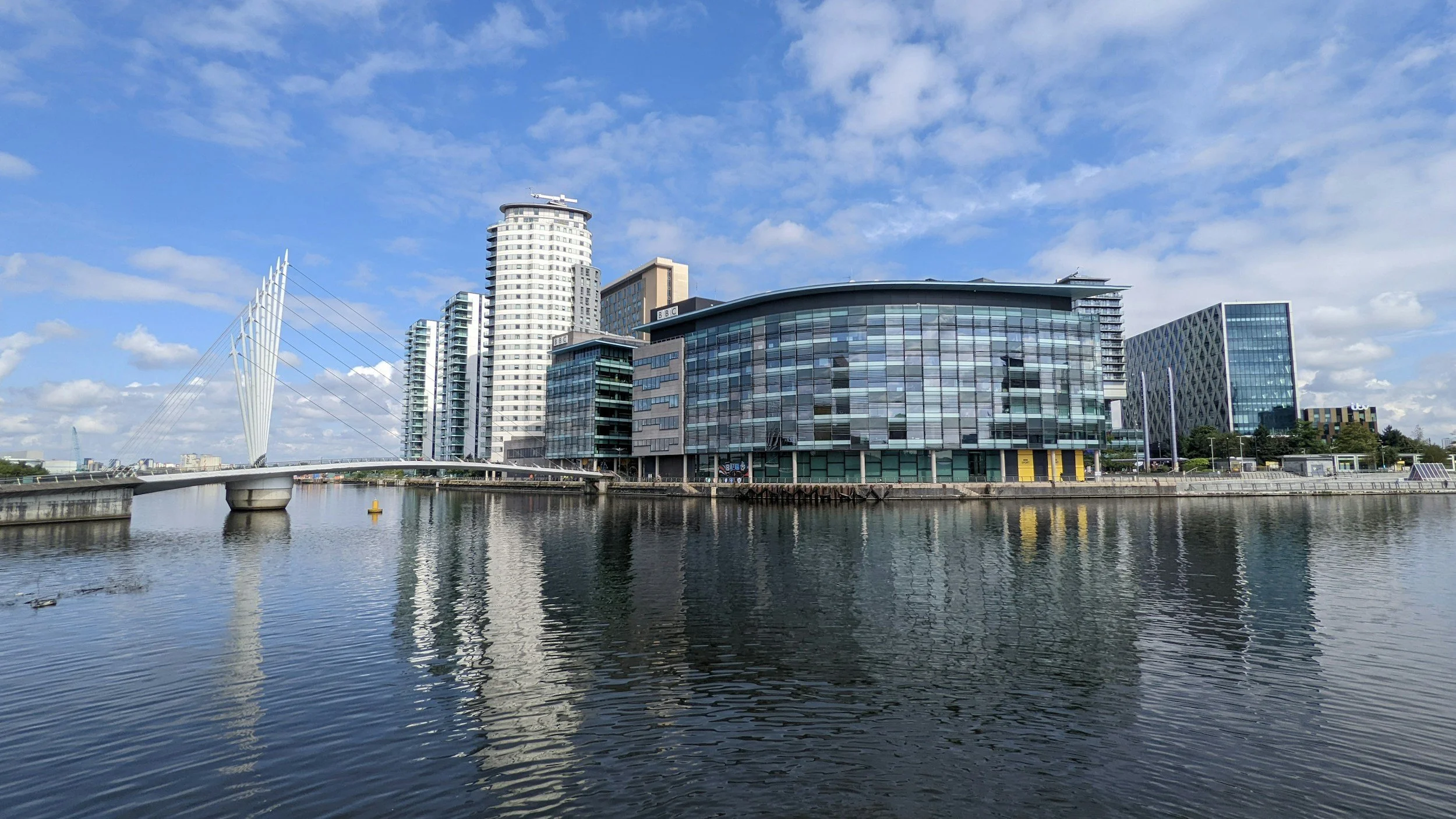
The transformation of Salford Quays and MediaCity helped turn former dockland into a major residential, commercial and technology district.
MediaCity is now home to organisations including the BBC, ITV and more than 250 creative and technology businesses, and the area is expected to continue expanding over the coming decade.
But Salford’s regeneration is nowhere near finished.
Salford City Council has set out ambitions for 40,000 new homes and 40,000 new jobs by 2040, concentrated across four strategic growth areas including City Centre Salford and MediaCity/Salford Quays.
Within MediaCity and Quayside alone, the adopted regeneration framework includes approximately 3,000 additional homes and around 75,000 square metres of business space.
A more accessible entry point?
This is where the comparison becomes interesting for investors.
Average property prices in Salford were approximately £232,000 in June 2026, considerably below Trafford's £397,000 average.
Average rents, meanwhile, reached approximately £1,167 per month, rising 3.6% over the previous year.
Salford therefore offers a different proposition.
Rather than entering one of the North West's more expensive local authority markets, investors can potentially gain exposure to Greater Manchester's economic growth at a lower average purchase price, while still benefiting from proximity to Manchester city centre and major employment hubs.
Current house-price performance also shows why investors should look beyond headline narratives. Salford's average price was down 2.4% year-on-year in June 2026, despite rents continuing to rise.
That doesn't undermine the regeneration story. It reinforces an important point:
regeneration is a long-term investment theme, not a guarantee that every postcode rises every year.
The property itself, purchase price and micro-location still matter.
Trafford or Salford: which is stronger for investors?
There isn't a universal answer.
Trafford currently presents a more established and higher-value market, coupled with some enormous regeneration projects still to come.
Salford offers a considerably lower average entry price alongside a mature regeneration story that continues to expand through MediaCity, Salford Quays and the areas closest to Manchester city centre.
For an investor focused heavily on capital growth and large-scale regeneration, Trafford may stand out.
For an investor looking for Greater Manchester exposure at a more accessible price point, parts of Salford could warrant closer attention.
Neither should be selected simply because of the borough name.
What should investors actually look for?
The Greater Manchester story is compelling, but the strongest investments tend to sit where several fundamentals overlap:
Regeneration: Is meaningful public or private investment actually committed?
Employment: Are jobs and businesses being created nearby?
Connectivity: Can residents easily access Manchester and other employment centres?
Housing demand: Who is actually going to rent or buy the property?
Entry price: Are you paying a sensible price relative to comparable property?
Supply: How much competing stock is being delivered?
Timing: Is the area already fully established, or is there still meaningful change ahead?
That final point is particularly important.
Investors rarely make money simply because they buy in a place that is already popular. The more interesting opportunities can appear when the fundamentals are strengthening before the full impact is reflected in property values.
Greater Manchester’s next chapter
Manchester's transformation over the past two decades is already well documented.
What investors should now be watching is how that success spreads across the wider city region.
Trafford is entering a major new period of development around TraffordCity and Old Trafford.
Salford continues to build on the success of MediaCity while planning tens of thousands of additional homes and jobs.
Both offer exposure to the wider Manchester economy, but through distinctly different investment cases.
And that is ultimately the point.
The investment opportunity isn't simply “Manchester”. It is identifying which areas around Manchester have the fundamentals, regeneration and demand capable of supporting the next phase of growth.
At Lion Rose, we assess property opportunities across Greater Manchester with a focus on location fundamentals, regeneration, rental demand and long-term growth potential.
To explore our latest Manchester investment opportunities, call us today or email hello@lionrose.co.uk.