
Long-term rental or short-term let?
It is one of the most common decisions facing property investors, and on paper the comparison can look fairly straightforward.
A long-term let offers predictable monthly rent and relatively simple management. A short-term let can command higher nightly rates and potentially generate significantly more revenue.
But headline income only tells part of the story.
The better investment ultimately depends on the property, its location, the costs involved and, importantly, what the investor is trying to achieve.
So how do the two strategies really compare?
The traditional route: long-term letting
Long-term letting has formed the backbone of buy-to-let investment for decades.
The model is simple. An investor purchases a property, rents it to a resident on a longer-term basis and receives an agreed monthly rent.
For investors looking for consistency and simplicity, there is plenty to like.
Once a good tenant is in place, rental income tends to be relatively predictable. There is less frequent turnover, fewer operational requirements and typically less day-to-day management than with a short-term property.
The main advantages of a long-term let
Predictable monthly rental income
Generally lower operating costs
Less intensive day-to-day management
Longer periods of occupancy
Strong demand in well-established residential locations
This can make long-term property particularly attractive for investors who want a relatively hands-off asset producing regular income.
Of course, that doesn't mean every long-term let performs equally well. Purchase price, local rental demand, achievable rent, service charges, management fees and maintenance all influence the eventual return.
The fundamentals still matter.
Why are short-term lets attracting so much attention?
Short-term letting takes a different approach.
Rather than renting a property to one resident for an extended period, the property is offered to guests for shorter stays, often through platforms such as Airbnb and Booking.com.
The major advantage is flexibility over pricing.
Instead of agreeing one monthly rental figure, nightly rates can respond to demand. Weekends, holidays, major events, conferences, football matches and seasonal travel can all create opportunities to achieve higher rates.
For the right property, that can translate into considerably greater revenue potential.
And the market itself is substantial. More than 100.9 million guest nights were recorded in UK short-term lets through Airbnb, Booking.com and Expedia Group during 2025, representing an 11.5% increase year-on-year.
Short-term accommodation has become a significant part of the wider UK rental and visitor economy.
The main advantages of a short-term let
Potential for higher rental income
Dynamic pricing based on demand
Greater flexibility over occupancy
Ability to benefit from tourism, events and business travel
Potentially attractive returns in high-demand locations
However, there is an important distinction between higher revenue and higher returns.
Gross yield can be misleading
This is where investors need to look beyond the headline figures.
Consider two properties purchased for the same price.
A long-term let generates £18,000 per year in rental income, while a short-term property generates £30,000 per year in bookings.
At first glance, the short-term option appears considerably stronger.
But the £30,000 isn't necessarily what the investor keeps.
Short-term properties can carry additional costs such as specialist management, booking platform fees, cleaning, utilities, Wi-Fi, linen, consumables, furnishing and greater ongoing maintenance.
A long-term property will have its own costs, but typically operates with a simpler expense structure.
This is why we believe net return is far more important than headline gross yield.
A short-term property generating significantly more revenue may still outperform the long-term alternative after costs — and in strong locations it certainly can. But the comparison needs to be made on realistic net figures rather than top-line income alone.
Location can completely change the answer
Perhaps the most important factor in deciding between the two strategies is location.
For a long-term rental, investors generally want areas with sustained residential demand. Employment, transport links, schools, universities, affordability and population growth can all support a healthy rental market.
Short-term lets need something slightly different.
There needs to be a consistent reason for people to visit and stay in that location.
That could include:
Tourism and leisure
Major employers and business travel
Sporting and entertainment venues
Universities
Strong transport connectivity
Waterfront or city-centre locations
Conferences and events
Major regeneration projects
The strongest short-term locations often combine several of these demand drivers.
Take a premium apartment close to restaurants, transport links, a major arena and a growing business district. The ability to charge different rates throughout the week and during major events could make short-term letting particularly attractive.
Move that exact same apartment to a quieter residential suburb and the economics could look very different.
The strategy has to suit the location.
Then there is occupancy
A strong nightly rate is only useful when people are actually booking the property.
Long-term letting generally offers greater visibility over occupancy. Once a tenant is in place, the property may remain occupied for an extended period with the same rent arriving each month.
Short-term occupancy will naturally fluctuate.
Some weeks may perform exceptionally well, while quieter periods may produce fewer bookings. This means short-term projections should be based on realistic annual occupancy rather than assuming peak nightly rates throughout the year.
A well-performing short-term investment therefore needs to achieve the right balance between nightly rate and occupancy.
Neither number should be considered in isolation.
Management: how hands-off do you want to be?
Management is another meaningful difference between the two strategies.
Once a long-term tenant is settled into a property, the ongoing workload can be relatively limited, particularly when a professional letting agent is managing the asset.
Short-term accommodation requires more active operation. Bookings, guest communication, cleaning, check-ins, pricing and ongoing property management all need to be coordinated.
For investors wanting a hands-off investment, this can be outsourced to a specialist operator.
That can make the experience considerably more passive, but naturally the management cost needs to be factored into the investment appraisal.
This leads to another important question for investors: are you trying to maximise income, minimise involvement, or find a balance between the two?
What about the Renters' Rights changes?
There is also a new factor to consider in 2026.
From 1 May 2026, England's private rental framework changed, with Assured Shorthold Tenancies moving into the new assured periodic tenancy system and Section 21 possession being abolished.
For most investors, this simply forms part of the modern long-term rental landscape.
However, it does add another distinction between the two strategies. Genuine short-term and holiday accommodation operates differently from a conventional assured residential tenancy, which may appeal to investors who particularly value flexibility.
It shouldn't be the sole reason for choosing short-term accommodation, but it is another consideration alongside income, costs, management and demand.
So, which one performs better?
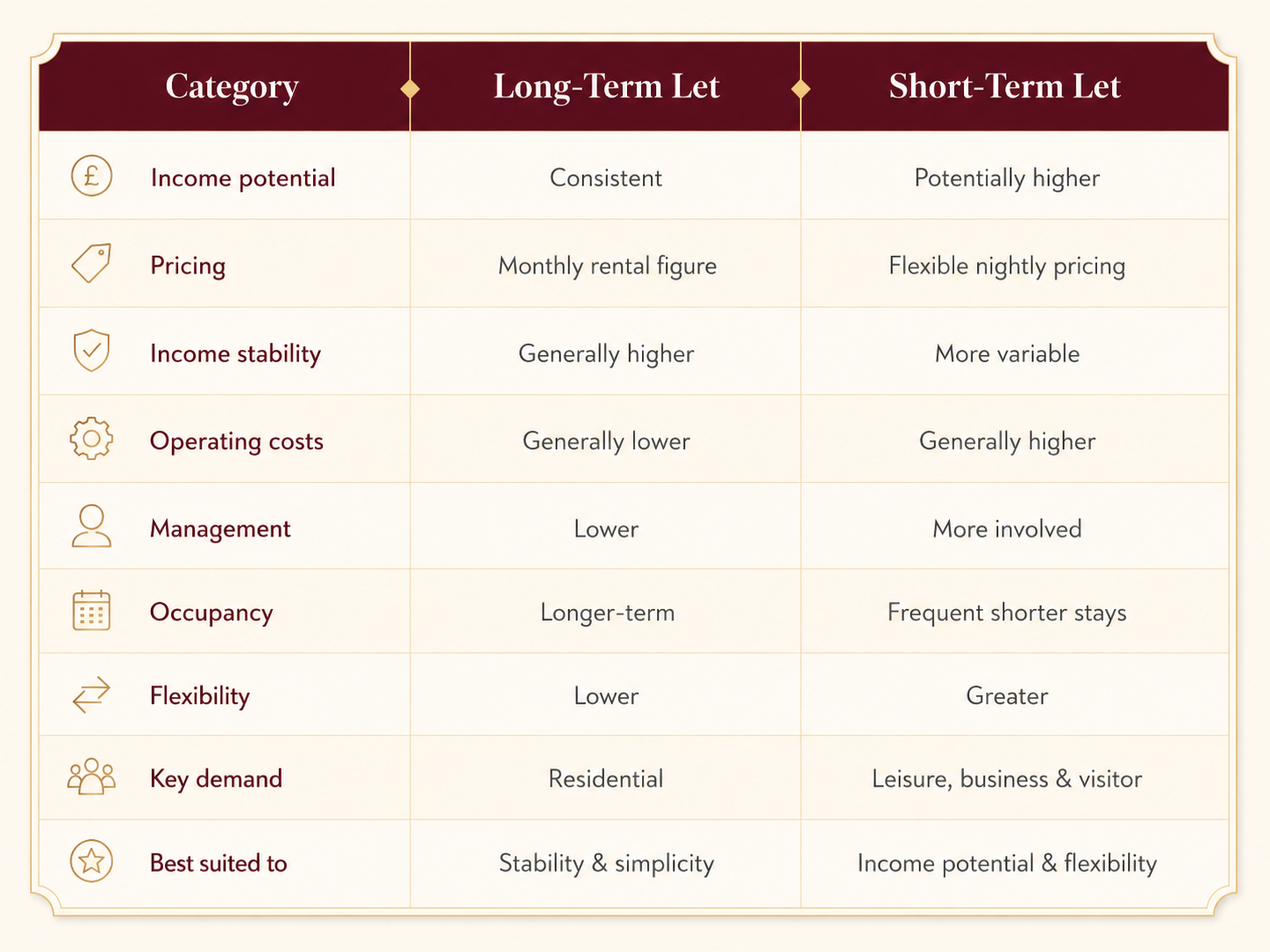
There isn't a universal winner — and that's perhaps the most important takeaway.
A well-selected long-term rental can comfortably outperform a poorly positioned short-term property.
Equally, putting the right property in the right short-term market can unlock income that simply wouldn't be achievable through a conventional monthly tenancy.
For investors prioritising predictable income, lower operating costs and simplicity, long-term letting can be an excellent fit.
For those prepared to accept greater variability and higher operating costs in exchange for increased income potential and flexibility, short-term letting can be extremely compelling.
The mistake is assuming one strategy is automatically superior.
Start with the investment, then choose the strategy
At Lion Rose, our view is that investors shouldn't begin with the question, “Should I buy a long-term let or an Airbnb?”
Start with the asset.
Is the purchase price attractive? What is happening in the surrounding market? Where will rental demand come from? What are the realistic costs? What can the property genuinely generate?
Only then should the rental strategy be considered.
A family home in an area experiencing strong residential demand may make an excellent long-term investment.
A well-located apartment surrounded by visitor attractions, major employers, transport links and entertainment venues may have significantly greater potential as a short-term rental.
The property, location and strategy should work together.
Ultimately, successful property investment isn't about chasing the highest advertised yield. It's about understanding what an asset can realistically generate, what it will cost to operate and how much of that income the investor ultimately retains.
If you're considering a property investment and would like to compare current long-term and short-term opportunities, speak with the Lion Rose team to discuss your objectives and explore our latest portfolio.
This article is intended for general information only and does not constitute legal, tax or financial advice. Individual properties, leases and investor circumstances vary, and appropriate professional advice should be obtained where required.